
Ryde Scrap Metal Collection at a Glance
Call 0411 398 285 or request a collection with your tonnage, site address and building access details.
| Local government area | City of Ryde, NSW |
|---|---|
| Main postcodes | Ryde 2112, Macquarie Park 2113, North Ryde 2113, West Ryde 2114, Meadowbank 2114 |
| Location | Northern Sydney — Macquarie Park sits approximately 13 km north-west of the Sydney CBD |
| Distance from our facility | About 25 km from South Granville |
| Primary volume source | Commercial, laboratory and institutional fitout and strip-out work |
| Lead service | Copper recycling — including structured data cabling and power cable |
| Also collected | Bulk scrap metal, bulk solar panel recycling |
| Minimum load | 3 tonnes per collection. Under-3t loads collected for a fee |
| Payment | Instant bank transfer once the load is weighed and graded |
| Collection hours | Monday to Saturday, 6am–6pm |
| Areas covered | Ryde, Macquarie Park, North Ryde, East Ryde, West Ryde, Meadowbank, Melrose Park, Gladesville, Marsfield, Denistone, Putney |
| Phone | 0411 398 285 |
| info@copperrecyclesydney.com.au |
Where the metal actually is in Ryde
Worth being specific, because Ryde is not an industrial area and a page pretending otherwise is no use to anyone. There are very few factories here. What there is instead is one of the largest concentrations of office, laboratory and research floorspace in New South Wales — and modern commercial buildings contain a surprising amount of recoverable metal.
Structured data cabling is the standout. A single floor of a Macquarie Park office tenancy can carry kilometres of Cat5e, Cat6 and Cat6a cable, and a precinct full of technology and pharmaceutical tenants refits on a regular cycle. Copper data cable is a real, gradeable material — priced on recoverable copper content rather than gross weight — and strip-out contractors frequently have tonnes of it in a skip before anyone thinks to grade it properly.
Mechanical services and plant rooms. Office and laboratory buildings run substantial HVAC plant. Chiller replacements, air handling unit upgrades, pump and motor changeovers and copper pipework from reticulation all produce bulk metal, and a plant room upgrade in a large building will routinely clear 3 tonnes on its own.
Laboratory and medical fitouts. Pharmaceutical, biotech, medical device and university research tenancies run stainless steel benching, fume cupboards, specialised plant and fittings. Laboratory decommissioning produces 304 and 316 stainless in quantity.
Partitioning, ceiling grid and fitout steel. Steel stud framing, suspended ceiling grid, shelving and storage systems from a full-floor strip-out add up quickly.
Light industrial pockets. Meadowbank, West Ryde and parts of North Ryde retain light industrial and trade premises, along with the Victoria Road commercial corridor — workshops, trades and service businesses that generate more conventional scrap.
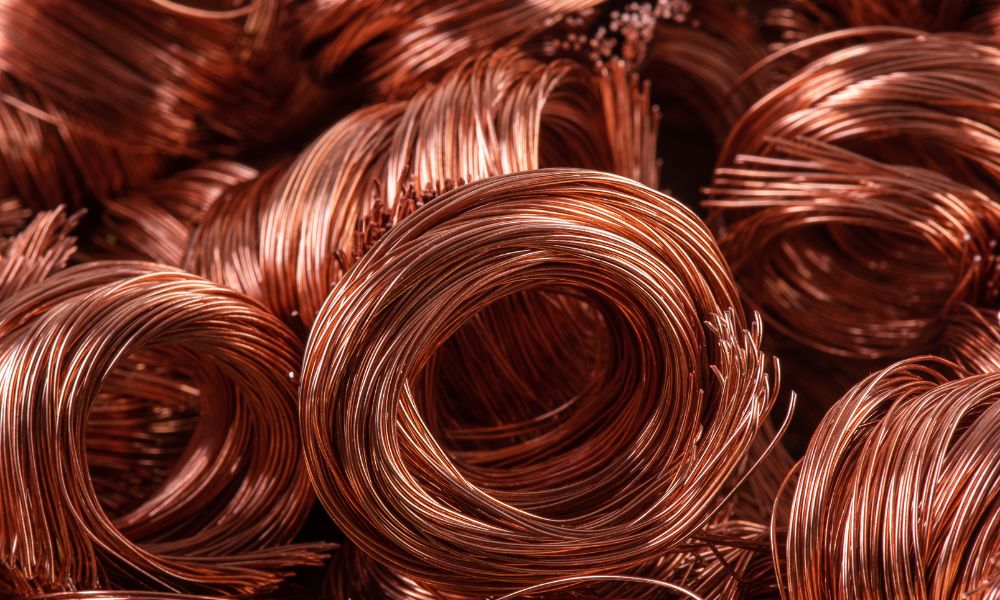
Copper recycling in Ryde — including data cable
Copper is our lead material and Ryde produces two distinct streams of it.
The first is conventional: copper pipe and fittings from plumbing and hydraulic works, bare bright and #1 copper from switchboard and distribution work, busbar, and motor windings from mechanical plant. The second is communications and data cabling — structured cabling, patch leads, backbone cable and coax from office and campus refits. Because insulated cable is priced on its recoverable copper content rather than its gross weight, it is also the material most often undervalued when it goes out mixed with general demolition waste.
We handle bare bright, #1 and #2 copper, insulated power and data cable, copper wire in reels and offcuts, pipe and fittings, and busbar. Grading is done at our facility and itemised on your transaction record, so you can see what each grade contributed. For a large strip-out, keeping cable separate from the general waste stream is the single highest-return decision available to the contractor.
See our copper scrap and copper wire scrap pages for grading detail.
Bulk scrap metal recycling for Ryde commercial sites
Alongside copper we recycle bulk ferrous and non-ferrous scrap from commercial, institutional and light industrial sites across the City of Ryde. This is a bulk-only service — we do not purchase small lots or individual items, and loads are assessed as a whole.
Typical Ryde collections include air conditioning and HVAC plant from mechanical upgrades, chillers, air handling units, pumps and electric motors, stainless steel from laboratory and commercial kitchen decommissioning, steel stud framing and ceiling grid from floor strip-outs, shelving and storage systems, structural steel from refurbishment work, aluminium from window, facade and partition systems, brass fittings and valves from hydraulic services, and mixed metal from site clean-outs.
Solar panel recycling
Bulk solar panel recycling is an additional service for installers, commercial property owners and decommissioning projects across Ryde. Solar panels are classified as e-waste in NSW rather than standard scrap metal, which brings separate handling, storage and transport obligations. Commercial and institutional rooftops across the Macquarie Park precinct carry significant installed solar, and the earliest arrays are now reaching end of life. We collect at 3 tonnes and above. See the solar panel recycling page.
About Ryde and the Macquarie Park precinct
The City of Ryde sits on the northern bank of the Parramatta River in northern Sydney, taking in Ryde, North Ryde, East Ryde, West Ryde, Meadowbank, Melrose Park, Putney, Denistone, Marsfield and part of Gladesville. Its defining feature for commercial purposes is Macquarie Park, which sits about 13 kilometres north-west of the Sydney CBD and has long been one of the largest concentrations of employment in New South Wales.
Macquarie Park was developed from the mid-1960s following the establishment of Macquarie University, deliberately modelled on the technology corridor that had formed around Stanford University in California. That origin still shapes its tenant mix. Multinationals with operations in the precinct include AstraZeneca, Johnson & Johnson, Novartis, Oracle, Siemens, Philips, Sony, Fujitsu, Hitachi, Toshiba and Wesfarmers — a concentration of pharmaceutical, medical device and technology occupiers that is unusual in Australia and directly relevant to the kind of metal the precinct produces.
Macquarie University occupies a 126-hectare campus at the precinct’s northern edge, with affiliated facilities including Macquarie University Hospital and the Cochlear Research Centre. Between the university, the hospital and the corporate tenancies, the area carries a continuous program of laboratory, office and plant room works.
Three underground Sydney Metro stations — Macquarie Park, Macquarie University and North Ryde — opened on 26 May 2019, and the resulting improvement in access has supported ongoing commercial development and refurbishment through the precinct. Elsewhere in the LGA, Meadowbank and West Ryde retain light industrial and trade premises, Top Ryde sits at the civic centre, and the Victoria Road corridor carries commercial and service businesses through to Gladesville.
The practical consequence for a recycler: Ryde’s metal arrives on a refurbishment cycle rather than a production cycle. It comes out in large, concentrated quantities when a tenancy changes or a building is upgraded, and in very little quantity in between. That makes advance notice and project scheduling more useful here than anywhere else we operate.
What we collect in Ryde
| Material | Typical Ryde and Macquarie Park sources |
|---|---|
| Copper data and communications cable | Structured cabling from office and campus refits, backbone cable, patch panels |
| Copper — bare bright, #1, #2, insulated power cable | Switchboard and distribution works, submains, plant room wiring |
| Copper pipe and fittings | Hydraulic services, chilled and heating water reticulation, plumbing refits |
| Stainless steel — 304 and 316 | Laboratory benching and fume cupboards, commercial kitchens, medical fitouts |
| Brass | Hydraulic fittings, valves, taps, mechanical hardware |
| Air conditioning and HVAC plant | Chillers, air handling units, ducted systems, condensers |
| Electric motors and pumps | Plant room equipment, air handling and hydraulic plant |
| Aluminium | Window and facade systems, partition framing, ceiling components |
| Ferrous and structural steel | Steel stud framing, ceiling grid, shelving, storage systems, refurbishment steel |
| Solar panels | Commercial and institutional rooftop array decommissioning |
Catalytic converters, batteries, car engines and electric motors are accepted as part of a qualifying bulk load rather than purchased as individual items.
Preparing a load in a commercial building
Ryde collections are usually inside an occupied building rather than on an open industrial site, which changes what matters:
Keep cable out of the general waste stream. This is the most valuable thing you can do on a strip-out. Data and power cable in its own bin or bundled separately grades properly; the same cable mixed with plasterboard and ceiling tiles does not.
Tell us the building access arrangements up front. Loading dock location and booking requirements, goods lift dimensions and weight limits, basement clearance height, after-hours access rules and building management sign-in. These determine what vehicle we send and how long the job takes.
Separate copper grades where practical. Bare bright, pipe and insulated cable kept apart grade more favourably than the same metal presented mixed.
Flag refrigerant and hazards. HVAC plant containing refrigerant, batteries from UPS systems and anything with residual fluids need identifying before we attend.
Give us the program, not just the date. On a staged strip-out, knowing when each floor comes down lets us schedule collections against the program rather than reacting to a full skip.
How collection works
Tell us what you have.
Call 0411 398 285 or submit an enquiry with material types, approximate tonnage, the site address and building access details.
We confirm the collection.
We check dock access, lift and clearance constraints, building management requirements and timing, and confirm whether the load qualifies at 3 tonnes.
We collect.
Our team attends with the appropriate vehicle and equipment, loads the material and leaves the area clear.
Weighing, grading and instant payment.
The load is weighed and graded, you receive an itemised transaction record, and funds are transferred to your account on settlement.
Who we work with in Ryde
- Commercial fitout and strip-out contractors
- Data and communications cabling contractors
- Mechanical services, HVAC and refrigeration contractors
- Electrical contractors and switchboard installers
- Hydraulic services and plumbing contractors
- Laboratory fitout and decommissioning specialists
- Facilities and property managers across the Macquarie Park precinct
- Institutional and campus facilities teams
- Light industrial and trade businesses at Meadowbank and West Ryde
- Solar installers and decommissioning projects
Areas we cover around Ryde
We collect throughout the City of Ryde, including Ryde, Macquarie Park, North Ryde, East Ryde, West Ryde, Meadowbank, Melrose Park, Marsfield, Denistone, Putney and Gladesville. Nearby areas with their own pages include Chatswood to the north, Artarmon to the north-east, Hornsby further north, Silverwater and Parramatta to the west, and Burwood to the south. The full list is on our service areas page.
Responsible recycling and compliance
Copper Recycle Sydney operates as a registered scrap metal business under the NSW Scrap Metal Industry Act 2016. For anyone selling to us in Ryde that means payment is made by bank transfer rather than cash, we record each transaction along with the seller’s details, and photo identification is required at the point of sale. These obligations apply to every registered dealer in NSW and exist to keep stolen metal out of the recycling chain.
For commercial fitout work the documentation side is usually the more relevant point. Head contractors and building owners increasingly require evidence of where strip-out material went, and Green Star or similar rating requirements may ask for diversion reporting. A recorded transaction with an itemised grade breakdown and an electronic payment trail is generally what those requirements ask for — and instant bank transfer gives you the speed of immediate settlement with the paperwork intact.
Material collected from Ryde is sorted, graded and processed back into manufacturing supply chains. Copper can be recycled indefinitely without loss of performance, and recovering it uses a fraction of the energy needed to produce primary copper from ore. On a data cabling strip-out in particular, the difference between grading that cable and skipping it is substantial — both in what you are paid and in what is actually recovered.
Frequently asked questions — scrap metal recycling in Ryde
Do you collect scrap metal in Ryde?
Do you buy data cabling and communications cable?
What is the minimum load size for a Ryde collection?
What happens if my load is under 3 tonnes?
How do you pay, and how fast?
Do you pay cash for scrap metal?
Do you buy individual items, like a single air conditioner or battery?
What types of metal do you collect in Ryde?
Can you collect from a commercial building with loading dock and lift restrictions?
Do you work with fitout and strip-out contractors on staged programs?
Can you provide documentation for diversion or Green Star reporting?
Do you collect laboratory and medical fitout material?
Do you provide bins for ongoing collection?
What identification or paperwork do I need?
How is the value of my load calculated?
Do you collect from Ryde households?
Are you a licensed scrap metal dealer?
Book a scrap metal collection in Ryde
If you have 3 tonnes or more of copper, cable, scrap metal or solar panels at a Ryde or Macquarie Park site, call 0411 398 285 or send us the details. Tell us the material types, rough tonnage, the site address and the building access arrangements, and we will confirm scheduling and what to expect on settlement.
Copper Recycle Sydney
South Granville, NSW 2142
Phone: 0411 398 285
Email: info@copperrecyclesydney.com.au
ABN: 82 419 348 954
Hours: Monday to Saturday, 6am–6pm